EMT Practice Test

1. Question Content...


Question List
Question1: Your test team is in the process of completing final regression testing one week before the release date. One of your staff has just uncovered a critical defect that causes data corruption.
What should you do? [2]

Question2: Improving the Testing Process
Which of the following statements about the TMMi test process improvement model is true?
Number of correct responses: 1
K2 1 credit

Question3: Test Management
You are managing the system testing for a SOA based system. The integrated system consists of several subsystems:
- a SOA middleware
- a CRM (Customer Relationship Management) system
- a BRM (Billing and Revenue Management) system
- a SMS (Subscriber Management System) system
and you performed a risk analysis based on these subsystems.
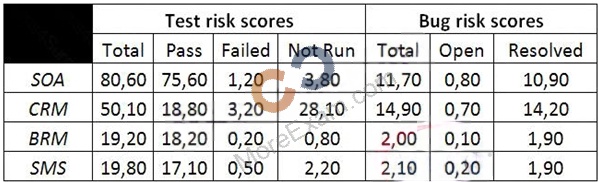
At the end of the scheduled period for test execution you produce a first classical report based on the traditional metrics of testing. Test pass/fail status and bug status (open/resolved) That table provides you a distorted picture of the quality risk, because there is no indication of the risk level of the failed tests, the tests not run, or the open bugs. Thus, you produce the following table to solve this distortion issue:

In the table above, where you have introduced the concept of risk weighting, the highest risk test or bug report has a score of 1, while the lowest risk test or bug report has a score of 0.04.
Which of the following subsystems, based on the risk scores of the table, is most risky?
Number of correct responses: 1
K43 credits

Question4: You are the Test Manager of a risk-based testing effort. You develop the following graph to show residual risk. Assume that "Risks mitigated" represents passed tests and "Risks not mitigated" represents failed tests and other discovered failures.
Which of the following answers best represents what the graph shows? [3]

Question5: The main objectives the senior management team wants to achieve are:
- to reduce the costs associated with dynamic testing
- to use reviews to ensure that the project is on course for success and following the plan
- to use reviews as a well-documented and effective bug-removal activity following a formal process with well-defined roles
- to determine the effectiveness of reviews in terms of phase containment
- to improve phase containment effectiveness
Which of the following answers would you expect to describe the best way to achieve these objectives?
Number of correct responses: 1
K4 3 credits

Question6: You are the Test Manager on a new project. The schedule is aggressive and will require the team to work at peak efficiency. The requirements are not well defined yet, but it is clear that the project will be using new technologies. To help the developers meet the development schedule, an offshore group will be added to the development team.
At this time there is not enough budget to add more testing resources. The project stakeholders are very concerned about the quality of the delivered product and will be watching the project closely, particularly during the testing cycles. The exit criteria from the system test level require no open high priority/severity defects, 100% pass rate for all test cases covering risks that are classified as "high" or "very high", 95% pass rate for all "medium" risks and 75% pass rate for all "low" and "very low" risks.
Given this information, which of the activities of the standard test process are the most critical for the Test Manager to perform? [3]

Question7: After the presentation, you are asked to explain the chart.
Assume you have applied a full risk-based testing strategy.

Which of the following answers would you expect to best describe the pie chart?
Number of correct responses: 1
K43 credits

Question8: Test Management
The following chart plots the cumulative number of defects opened against the cumulative number of defects closed during system testing of a software product.

Which of the following statements is true?
Number of correct responses: 1
K21 credit

Question9: What is a "depth-first" risk-based testing technique? [1]

Question10: You have done a comprehensive risk analysis. You have involved the appropriate people in assessing the risks and determining the likelihood and impact of those risks. You have been testing for three months and have been able to mitigate 75% of the high risk items. You have two weeks left in testing and you now do not expect to be able to complete all the items on the high-risk mitigation list, never mind any from the medium or low-risk lists.
What is the most effective action you should take? [3]

Question11: Which of the following is a key characteristic of a management review? [1]

Question12: Defect Management
Assume you are working on a defect management process to be used by a software organization to track the current status of the defects reports for several projects.
When a defect is found for investigation a defect report is created in "Opened" state that is the unique initial state. The defect report status has also a unique finale state that is the "Closed" state.
The following state transition diagram describes the states of this defect management process:

where only the initial ("Opened") and final ("Closed") states are indicated while the remaining states (V, W, X, Y, Z) have yet to be named.
Which of the following assignments would you expect to best complete the defect management process?
Number of correct responses: 1
K32 credits

Question13: People Skills - Team Composition
Which of the following would you expect to be most likely an example of a demotivating factor for testers?
Number of correct responses: 2
K21 credit

Question14: You have been carefully monitoring the progress of testing for your project. You have been using the established traceability to verify that the requirements and test conditions are being adequately addressed. The test team is proceeding well in their test case execution and you can see that you are achieving about 80% coverage of the test conditions per the traceability mapping in your test management system. You have seen a number of defects being logged against test conditions that are failing, but you do not see a mapping of the test cases to those conditions.
What is likely to be occurring in the testing area that is causing the traceability to break down? [2]

Question15: You have been promoted to Test Manager within your company. Your new manager states that your test team utilized a risk-based test approach for the last release but in production, a number of serious failures in lightly tested areas have occurred.
What would be your first action prior to the start of the next test phase for the next release? [3]

Question16: People Skills - Team Composition
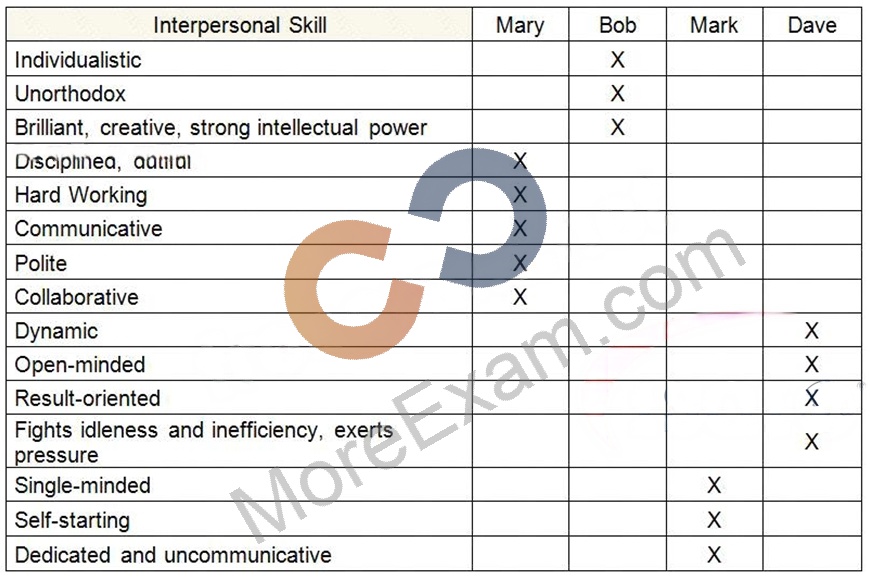
Your test team consists of four members (Mary, Bob, Mark, Dave) with different interpersonal skills.
The following skills assessment spreadsheet shows the characteristics of the team members with respect to a list of interpersonal-skills (for each characteristic only the member with the highest level of that characteristic is indicated and marked with 'X'):

On the next project a member of your test team will have to perform some routine tasks requiring collaboration with other teams.
Who in your test team would you expect to be most suitable at doing these tasks?
Number of correct responses: 1
K43 credits

Question17: When, at a minimum, should project risks be re-evaluated? [1]

Question18: Which work experience is likely to develop the necessary skills to effectively test a software system? [3]

Question19: The following is the unique "critical" quality risk item that has been identified:
CR-RSK-1. The GUI of the application might accept non-integer values for the input field designed to get the number of bottles from the user Test analysis for system testing has just begun and the following test conditions have been identified:
TC-SEL-2. Test the selection of the package sizes
TC-SEL-4. Test wrong numbers of bottles for an order
TC-CR-RSK-1. Test the accepted values from the input field designed to get the number of bottles from the user What is the MINIMUM number of test conditions that must be added to fulfill both the EXCR1 and EXCR2 exit criteria?
Number of correct responses: 1
K3 2 credits

Question20: Testing Process
Which of the following is an example of the test closure activity indicated as "lessons learned"?
Number of correct responses: 1
K2 1 credit

Question21: Reviews
You are a Test Manager working for a software organization where reviews have never been applied. After a meeting with your managers examining a business case for reviews, (including their costs, benefits, and potential issues), the management finally decides to adopt formal reviews for future projects.
You have been given a budget that you have spent to provide training in the review process and to introduce the review process on a pilot project.
On that pilot project the introduction of reviews has been very positive in terms of positive involvement from all the participants. All the reviews applied to different documents have been very effective for their purposes (especially at revealing defects).
Which of the following answers describes an important success factor for the introduction of formal reviews which is missing in this scenario?
Number of correct responses: 1
K4 3 credits

Question22: When closing out a defect report, which of the following developer commentaries is most likely to motivate a tester? [1]

Question23: The following are the requirements identified as "critical":
REQ-SEL-001. The user shall be able to combine all the three products with all the four durations to define an item to purchase REQ-SEL-002. The user shall be able to add a maximum of six different items to the shopping cart REQ-PUR-001. The user shall be able to purchase all the items in the shopping cart using a credit voucher REQ-PUR-002. The user shall be able to purchase all the items in the shopping cart using the available credit already charged on the smartcard REQ-PUR-003. The user shall be able to purchase all the items in the shopping cart using all the accepted credit cards (Visa, MasterCard and Great Wall Card) REG-LOGO-001. The user shall be able to logout (by clicking the logout button) from both the "select" and
"purchase" pages going back to the "browse" page (anonymous navigation) Moreover the following quality risk item has been identified as "critical":
QR-P1. The web customer portal might not be able to provide the expected response time (less than 10 sec) for the purchase transactions under a load of up-to 1000 concurrent users Test analysis for system testing has just begun and the following test conditions have been identified:
TC-SEL-01. Test the combinations of products and durations to define an item to purchase TC-SEL-02. Test the maximum number of items, which can be added to the shopping cart TC-PUR-01. Test the purchase of an item TC-PUR-02. Test the purchase of an item with the credit charged on the smartcard Assume that you have used traceability to determine the logical test cases that cover all the requirements and the single risk item identified in that scenario.
Which of the following is a positive logical test that is complete, is correct, and covers the REG-LOGO-001 requirement?
Number of correct responses: 1
K3 2 credits

Question24: Test Management
Assume you are managing the system testing phase of a project.
The system test execution period is scheduled to twenty weeks.
All tests are manual tests. You are following a risk-driven test approach.
During the last staff meeting the project manager tells you new deadlines that will not allow completion of all the system tests.
Which of the following would you expect to be the best way to respond to this situation?
Number of correct responses: 1
K2 1 credit

Question25: Test Management
Based on the historical data of 5 past and similar projects, you have calculated these average numbers of defects detected in system testing:
- for each 10000 LOC (lines of code), 200 defects
- for each person-month of development team effort, 49 defects
You want to use this information to perform estimation for a new project.
The project manager tells you that he/she has estimated 20000 new LOC for this new project.
Four developers work for four months on this project before system testing.
During system testing, 797 defects are discovered.
Assume that the system test of this new project is using the same amount of work as spent in the past projects.
Based on this information only, which of the following statement is certainly true about this project?
Number of correct responses: 1
K3 3 credits

Question26: Test Management
You are performing a quality risk analysis for a CSCI (Computer Software Configuration Item) used to implement a CBIT (Continuous Built-In Test) module of a safety-critical system.
During the quality risk analysis you are trying to identify the ways in which failures of the CBIT module can occur, for each of them trying to determine the potential causes and likely effects, and the risk level (calculated as the product of three factors: severity, occurrence and detection).
Which of the following risk analysis techniques are you working with?
Number of correct responses: 1
K2 1 credit

Question27: People Skills - Team Composition
Assume you are managing the system testing execution phase of a project.
The system test execution period for that project is scheduled for eighteen weeks and the release date is scheduled at the end of system testing.
During the sixth week of system test execution, at the staff meeting, the project manager informs you that the project deadlines are changed and the release date that is only three weeks ahead.
This new release will not allow the completion of the system tests. Suppose also that you have followed a risk-driven test approach for this project.
Which of the following statements represents the worst way to lead your test team in the next three weeks?
Number of correct responses: 1
K2 1 credit

Question28: Your testing team has just received the test conditions for a new project. You are conducting Test Design activities for this project. Your team feels that it would be beneficial to create high-level test cases.
What should they do concurrently with creating these test cases? [2]

Question29: During what step of the Fundamental Test Process should you define the methods to be used to collect test metrics? [1]

Question30: Test Management
Consider the following test strategies:
I. Consultative test strategy
II. Reactive test strategy
III. Analytical test strategy
IV. Process-compliant test strategy
Consider also the following examples of test activities:
1. Prioritize the test cases, based on the results of a FMEA analysis, to ensure early coverage of the most important areas and discovery of the most important defects during test execution
2. Execute usability testing driven by the guidance of a sample of users (external to the test team)
3. Perform exploratory testing sessions throughout the system test phase
4. On an Agile project, execute tests that cover the test conditions identified for each user story of a feature planned for an iteration Which of the following correctly matches each test strategy with an appropriate example?
Number of correct responses: 1
K21 credit

Question31: What is the primary use for the traceability information regarding the relationship between test results and test conditions during test execution? [2]

Question32: Improving the Testing Process
Which of the following statements about the STEP test process improvement model is true?
Number of correct responses: 1
K2 1 credit

Question33: Test Management
For which of the following activities would the costs be classified as a cost of detection?
Number of correct responses: 1
K2 1 credit

Question34: Test Management
You are working on a project to develop an authentication system for an e-commerce website. This system provides two features: Registration and authentication. Two different development teams develop these two features.
There is a high likelihood that the delivery of the authentication feature to the test team will be three weeks later. To complete the registration the user must provide the following registration inputs: Name, surname, birthdate, fiscal code and he/she can select a username and a password.
A registered user can be a special user or a normal user. To be identified as a special user, he/she must also provide, during the registration process, a voucher possibly received from the IT department.
Access is granted only if a user is registered and the password is correct: In all other cases access is denied. If the registered user is a special user and the password is wrong, a special warning is shown on the system console.
You are currently performing a quality risk analysis using FMEA.
Based only on the given information, which of the following is NOT a product risk that could be identified during the quality risk analysis?
Number of correct responses: 1
K4 3 credits

Question35: What test process is included as part of TPI Next? [1]

Question36: While mining the defect database for patterns of problems in the last release, a Test Manager notices that many of the most damaging failures were caused by defects injected during the low-level design phase.
Which of the following actions will likely give this project the most effective solution to this problem? [3]

Question37: Test Management
Which of the following statements describing how identified product quality risks should be mitigated and managed, is true?
Number of correct responses: 1
K2 1 credit

Question38: Your Project Manager has challenged you to come up with a process improvement strategy using the IDEAL model.
Which step within the process defines the success criteria? [2]

Question39: Defect Management
Which of the following information would you expect to be the most useful to perform a defect clustering analysis?
Number of correct responses: 1
K2 1 credit

Question40: You are managing a project that will be using a model-based testing strategy.
Which of the following is an activity that will be needed in order to implement this strategy? [1]

Question41: Test Management
Which of the following statements about management of product quality risks in mature organizations with respect to the lifecycle, is true?
Number of correct responses: 1
K2 1 credit

Question42: Which of the following organizational structures would be considered unorthodox? [1]

Question43: Test Management
Which of the following statements, about the test reporting activities for a project adopting an iterative lifecycle model with very short iterations (e.g. two weeks iterations), is correct?
Number of correct responses: 1
K2 1 credit

Question44: You can count on well-written requirements, but you can't count on an adequate contribution of the stakeholders to the quality risk analysis. You have to mitigate the insufficient contribution of the stakeholders because the risk-based testing approach shall minimize the product risks. Your test team has one expert tester in security testing.
Which of the following test activities would you expect to be the less important in this context?
Number of correct responses: 1
K4 3 credits

Question45: Test Management
Which of the following answers describes a factor that may reduce the effort spent when using distributed test teams without negatively affecting system quality?
Number of correct responses: 1
K2 1 credit

Question46: Your test process is fully integrated into the software development lifecycle. You are at which TMMi level?
[1]

Question47: Test results are reported as "Requirements tested, passed, and failed".
What test strategy are you using?[1]

Question48: You are not confident with the assessment of the risk level and you suspect that it will be possible to find high-priority bugs in low-risk areas.
Furthermore the period for test execution is very short. Your goal is to test all the product risks in a risk-based way, while assuring that each product risk gets at least some amount of testing.

Which of the following answers describes the best test execution schedule in this scenario?
Number of correct responses: 1
K32 credits

Question49: During the follow-up phase the following conditions are checked:
X1. The code has been completely reviewed
X2. All the identified defects have been correctly fixed and the modified code has been compiled successfully and run through all the static analyzers used by the project without warnings and errors X3. The modified code is available under the configuration management system with a new version number for the specified CI If these conditions are fulfilled then the review process terminates.
Which of the following characteristics of a formal review is missing in this description?
Number of correct responses: 1
K2 1 credit

Question50: Reviews
Consider the following list of statements about audits and management reviews:
I. Audits are usually more effective than management reviews at finding defects II. Audits and management reviews have the same main goals, the only difference is related to the roles and level of formality III. A typical outcome of an audit includes observations and recommendations, corrective actions and a pass/fail assessment IV. An audit is not the appropriate mechanism to use at the code review in order to detect defects prior to dynamic testing Which of the following statements is true?
Number of correct responses: 1
K2 1 credit

Question51: You are following a risk-based testing strategy. The test execution time is very limited. Assume that all the product risk items require more or less the same level of test effort.

Which of the following answers describes the best execution schedule in this scenario?
Number of correct responses: 1
K33 credits

Question52: Consider the following scenario:
Your customer is closely involved in the development project. Requirements are communicated verbally and rarely written down. An iterative development model is being followed and time boxing is used to stay on schedule.
Which of the following statements is true? [3]

Question53: Mary is an external IT auditor. She is conducting a review of the system-level testing done by Greg's functional testing team.
Which of the following items from Mary's assessment summary should concern Greg the most? [2]

Question54: Test Management
Assume you are currently working on a project developing a system where functional requirements are very well specified. Unfortunately non-functional requirements do almost not exist.
You are the Test Manager. You have to choose a technique for test selection that allows testing of non-functional characteristics, especially reliability.
Which of the following techniques for test selection do you expect being most useful in this scenario?
Number of correct responses: 1
K2 1 credit

Question55: You are responsible for porting a performance testing tool to a new operating system. You are at what stage in the tool's lifecycle? [1]

Question56: You are the Test Manager for a new product that is being developed according to an iterative lifecycle. At this point, you have 100% of your smoke tests automated, 20% of your functional tests and 50% of your regression tests. Your iterations are four weeks long. You are finding that with each iteration significant maintenance is required for your automated tests and you are not able to complete the testing within the planned timeframe. The test plan you created at the beginning of the project indicates that all automated tests should be run before any manual tests.
Which of the following is a reasonable change to this plan based on how the project is going? [2]

Question57: You are testing a new product that will turn on the windshield wipers of a car when the sensors detect there is moisture on the windshield. Depending on the information returned from the sensors, the wipers will be turned on at one of the following speeds: slow intermittent, medium intermittent, fast intermittent, slow constant, medium constant, fast constant. Your team has identified the following test condition:
Test Condition 1.1.1 - Verify that the windshield wipers can go from slow constant to fast constant speed when the amount of moisture increases appropriately.
Your team has defined the following steps for a test case for this test condition:
1. Set the moisture sensor to request slow constant
2. Increase the moisture to set the sensor to request fast constant
3. Verify that the wipers respond with fast constant speed
Given this information, which of the following statements is correct? [2]

Question58: You are the Test Manager for a critical system and are using a risk-based approach for this project.
Which of the following would most clearly convey the current status to project stakeholders? [3]

Question59: People Skills - Team Composition
Consider the following analysis of testing skills performed on four people: Alex, Robert, John and Mark (all the skills have been rated on an ascending scale: The higher the score, the better the skill):

Which of these people, based on this analysis, would you expect to be most suitable to work specifically as test designer?
Number of correct responses: 1
K43 credits

Question60: Defect Management
During the system testing phase a tester from your test team observes a failure in the system under test and he/she decides to create an incident report. The incident report is currently in a "new" state, indicating it needs to be investigated.
Which THREE of the following information items can't yet be present in the incident report?
Number of correct responses: 3
K3 2 credits (2 credits out of 3 credits correct, 1 credit point)

Question61: Test Management
Which of the following statements best describes an appropriate approach for managing exploratory testing?
Number of correct responses: 1
K2 1 credit

Question62: You are the manager of a test team. You inherited most of these people from a previous manager who promoted technical skills, particularly programming skills. As a result, your people are very strong in test automation skills, white box testing and complex test design techniques. You have just been told that you can hire five new people. You want the new people to complement the existing skill sets and you want to be sure the team will have a strong mutual respect.
Given the following options, who should you hire? [3]

Question63: Most managers in your company consider the efforts of your test team valuable, while others see comprehensive testing as an unnecessary cost overhead to the SDLC.
What action could the Test Manager take to quantify the value of testing to the organization? [3]